
Written by Omar Farrell, health-industry reporter. Last reviewed March 2026.
Here’s the mix-up that keeps happening: people hear “PT-141” and “oxytocin” in the same breath, filed under the same mental folder labeled “peptides that help with intimacy,” and they assume the choice between them is mostly a matter of taste. It isn’t. These two work on completely different systems in the body, they’re backed by very different amounts of real evidence, and they carry very different risks. This piece lays out what’s actually known about each, in the order most people worry about it: what it does, whether the FDA stamp means what you think, whether the evidence holds up, and how to get either one without taking on risk nobody’s watching for. Every number below traces back to an FDA label, a peer-reviewed trial, or a published methods review, listed at the end.
The short version, so you’re not left guessing
PT-141 (bremelanotide) is a brain-acting drug, approved by the FDA for one narrow group: premenopausal women with hypoactive sexual desire disorder, sold as Vyleesi [P2][P3]. It has real controlled-trial evidence behind that specific use, plus a genuine cardiovascular caution that can rule it out for some people.
Oxytocin, the hormone behind all the “love hormone” talk, is also FDA-approved, but only as an injectable drug (Pitocin) used in hospitals for labor and postpartum bleeding [O1]. The bonding, trust, and libido uses people actually buy it for are off-label, and the research behind those uses is thin and, in some cases, doesn’t hold up when checked closely.
That’s the shape of it. The rest of this piece is about why, because the “why” is what should actually decide which one, if either, makes sense for you.
First worry: are these even the same kind of thing?
Not really, and this matters more than it sounds like it should. PT-141 acts on melanocortin receptors in the brain, mainly MC1R and MC4R, with the MC4R activity being the piece tied to sexual desire specifically [P4]. It’s aimed, mechanistically, at desire.
Oxytocin acts on its own receptor system tied to bonding and social behavior. The wellness pitch built around it, closeness, trust, sometimes libido, comes from that different pathway. So if your actual goal is low sexual desire, PT-141’s mechanism is the one pointed at that problem. If your goal is more about feeling emotionally closer to someone, oxytocin is the one marketed toward that, though as the evidence sections below show, being marketed toward something and being shown to do it are not the same claim.
Second worry: “But it says FDA-approved, so it’s fine, right?”
This is the trap almost everyone falls into, and it’s worth slowing down on. Both drugs really are FDA-approved. That part is true. PT-141 is approved as Vyleesi [P2]. Oxytocin is approved as the injectable Pitocin [O1]. A seller can say “FDA-approved” about either one and not be lying.
But look at what each approval actually covers. Vyleesi’s label covers only premenopausal women with HSDD, and it specifically excludes men, postmenopausal women, and general performance use [P3]. Pitocin’s approval covers only inducing labor or controlling bleeding after delivery, given by IV in a hospital [O1]. Neither label says a word about bonding, trust, or everyday libido.
So the honest read is: both are approved drugs, and neither is approved for the reason most people are reaching for them. “FDA-approved” and “FDA-approved for what you want it to do” are two different sentences. Keep that distinction in your back pocket, because it’s the thing marketing tends to blur.
Third worry: does the evidence for my actual goal hold up?
This is where the two genuinely part ways, and it’s the round that should carry the most weight in your decision.
PT-141 has real, if modest, evidence behind it. The RECONNECT program ran two randomized, double-blind, placebo-controlled Phase 3 trials in about 1,267 premenopausal women with HSDD [P1]. Bremelanotide beat placebo on both desire and distress, with an integrated improvement in desire score of roughly 0.35 and a drop in distress of roughly 0.33, both statistically significant [P1]. That’s not a dramatic effect, and it wasn’t tested in men, but it’s genuine controlled evidence in the group it was studied in.
Oxytocin’s evidence for the uses people actually want, bonding, trust, libido, is weaker, and this comes from the field’s own accounting, not from skeptics outside it. A methodological review put the average statistical power of intranasal oxytocin studies at around 16% in healthy volunteers and 12% in clinical populations, concluding that most reported positive results are likely false positives [O3]. Its best-known finding, that it boosts trust, hasn’t held up under closer review [O4]. And the largest, most careful clinical test to date, a Phase 2 trial of 290 children and adolescents with autism, found that daily intranasal oxytocin did not significantly improve social functioning compared with placebo [O5]. So one side has a modest, real signal in a defined group. The other has a signal that keeps fading when researchers look harder at it.
Fourth worry: does the drug even get where it’s supposed to go?
Fair question, and it’s one the marketing rarely raises. PT-141 is injected and acts centrally, with absorption defined for its approved route [P3]. Whatever else you think about it, it gets into the system in a way that’s been characterized.
Intranasal oxytocin has a harder problem here. A widely cited analysis found that very little of the oxytocin sprayed into the nose actually reaches the cerebrospinal fluid, even as blood levels elsewhere in the body rise sharply [O2]. Put plainly: a lot of what goes up the nose may never reach the brain, where the bonding effect is supposed to happen, while still circulating through the rest of the body. That’s a basic delivery issue sitting underneath everything else. It’s hard to trust a claimed brain effect from a product that may not reliably get to the brain.
Fifth worry: what could actually go wrong?
Here the picture flips, and this is the round where PT-141 deserves genuine caution rather than oxytocin.
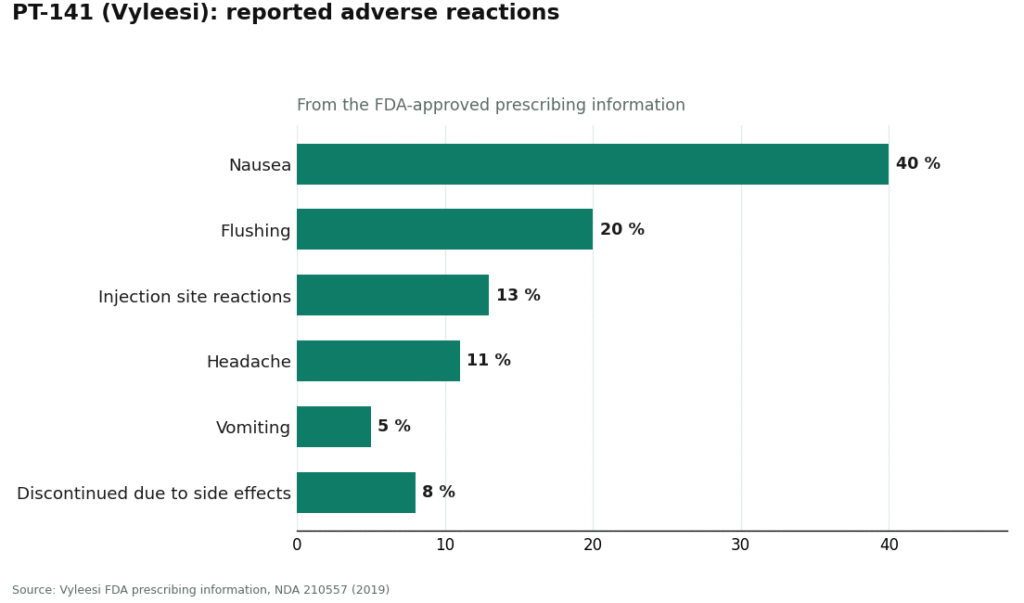
PT-141’s side effects are documented in detail. Nausea shows up in 40% of users, with 13% needing anti-nausea medication and 8% stopping the drug altogether [P3]. It also causes a transient rise in blood pressure and drop in heart rate with every dose, and it’s contraindicated in anyone with uncontrolled hypertension or known cardiovascular disease [P3]. That contraindication is arguably the single most important line on this whole comparison, because it can take the drug off the table for a person entirely, no matter how well it might otherwise fit their goal. Frequent use also carries a skin-darkening risk that climbs sharply with overuse [P3].
Nasal oxytocin tends to report milder side effects. But its real weak point isn’t a scary side-effect list, it’s that the effect you’re buying it for is itself in doubt [O2][O3]. So this isn’t a symmetrical trade. PT-141’s risk is concrete and calls for real cardiovascular screening before use. Oxytocin’s risk is closer to “probably gentle, possibly doing very little.”
So which one actually fits your situation?
If low sexual desire is the specific problem, and you don’t have a cardiovascular contraindication, PT-141 has a mechanism aimed at that exact issue and modest, real controlled evidence behind it, with the caveat that the strong evidence sits in premenopausal women, and use outside that group, including in men, is off-label and untested at that level [P1][P3]. Your blood pressure and heart history are the deciding factor here, since the contraindication can rule this out regardless of how well it otherwise fits [P3].
If the goal is more about emotional closeness or general wellness, oxytocin is what’s marketed for that, but it’s fair to go in clear-eyed: the human evidence is weak and inconsistent, its best-known finding hasn’t replicated well, and the nasal route may not reliably deliver it to the brain at all [O2][O3][O4][O5]. Unproven isn’t the same as disproven, and a cautious person might still try it, just not on the assumption the data backs it strongly, because right now it mostly doesn’t.
And if what you want is a guarantee from either one, neither offers that, and anyone promising it is getting ahead of what the studies actually show.
The worry that applies no matter which one you pick
Whichever drug fits your goal, there’s a second question hiding underneath it: how do you actually get it without taking on risk that has nothing to do with the drug itself?
There are, broadly, two routes. One is the unscreened market: a listing online, a box checked for “research purposes,” and a powder in the mail with nobody checking whether you should be taking it, nobody accountable if something goes wrong, and no FDA verification of what’s actually in the vial. For PT-141 specifically, that route skips right past the cardiovascular screening that matters most, the one safeguard on this entire comparison capable of preventing real harm.
The other route is supervised: a licensed clinician reviews your history, prescribes only where it fits, and a licensed pharmacy compounds and dispenses what’s actually written. FormBlends operates a clinician-first telehealth model built around that second path, the same molecules the gray market ships blind, but with a prescriber and a pharmacy standing behind them. There’s nothing to buy here and no checkout to click through in this piece, just a plain description of the model that puts a real screening step between you and a drug that, in PT-141’s case, genuinely needs one.
The short version, one more time: PT-141 is a real drug with narrow, modest proof and a real cardiovascular caution attached. Oxytocin is a real hormone whose trendy uses remain largely unproven and may not even reach the brain reliably. The right choice is the one that matches your actual goal, and it should run through a route where someone qualified is watching for the risks that apply to you specifically.
Questions readers tend to ask next
Is PT-141 or oxytocin better for low sexual desire specifically? PT-141 fits that goal better. Its mechanism acts on the MC4R brain pathway tied to desire, and the RECONNECT Phase 3 program showed a modest but real effect in roughly 1,267 premenopausal women with HSDD [P1][P4]. Oxytocin leans more toward bonding and closeness in its marketing, and its evidence for libido specifically is weak and inconsistent [O3][O4]. The catch with PT-141: the strong evidence sits in women, and male use is off-label.
Both are FDA-approved. Doesn’t that settle it? Not quite. Both are genuinely approved drugs, but neither is approved for what most buyers actually want. PT-141 is approved as Vyleesi only for premenopausal women with HSDD, and the label excludes men, postmenopausal women, and general performance use [P2][P3]. Oxytocin is approved as Pitocin only for labor and postpartum bleeding, given by IV in a hospital, with nothing said about bonding, trust, or libido [O1]. “Approved” and “approved for your goal” are two different claims worth separating.
Why do people say nasal oxytocin might not even reach the brain? Because a widely cited analysis found that very little of the oxytocin sprayed into the nose actually reaches the cerebrospinal fluid, while blood levels elsewhere rise sharply instead [O2]. In practical terms, much of the dose may circulate through the body without arriving where the bonding effect is supposed to happen. That delivery gap is a core reason the wellness case for nasal oxytocin stays shaky no matter the dose.
Which one carries the more serious safety concern? PT-141’s concern is the more concrete one. It transiently raises blood pressure and lowers heart rate with every dose, and it’s contraindicated in anyone with uncontrolled hypertension or known cardiovascular disease, which can take it off the table entirely for some people [P3]. Nasal oxytocin tends to report milder side effects, so its main issue isn’t danger so much as doubt about whether it’s doing much for the brain-based goal at all [O2][O3].
What about men who want to try either one? For men, both sit in off-label territory with thin support. PT-141’s controlled HSDD evidence comes from premenopausal women, so male use is outside the studied population [P1][P3]. Oxytocin’s effects on men’s sexual experience are limited, one study found increased orgasm intensity and post-sex contentment reported more by men, but no change in drive or arousal [O5]. Neither drug has male-specific efficacy data solid enough to make the decision easy.
What’s the safer way to get either of these if I decide to try one? Through supervised access rather than an unscreened online seller. A licensed clinician can review your history, check whether PT-141’s cardiovascular contraindication applies to you, and prescribe only when it makes sense, after which a licensed pharmacy compounds and dispenses it [P3]. The unscreened route skips that check entirely and offers no FDA verification of identity, strength, or purity, a gap that matters most for PT-141, where the screening step is a genuine safeguard, not paperwork.
What is PT-141, in plain terms?
PT-141 (bremelanotide) is a synthetic peptide that activates melanocortin receptors in the brain, specifically MC3R and MC4R, to trigger sexual arousal through the central nervous system rather than through blood flow the way older erectile-dysfunction drugs work. The FDA approved a version called Vyleesi for women with hypoactive sexual desire disorder in 2019. That brain-based mechanism is what sets it apart, and it’s also behind most of its side effects, like nausea and flushing.
How long does a dose of PT-141 last?
Most people notice effects within 30 to 60 minutes of a subcutaneous injection, with the strongest window landing somewhere between one and three hours in. Arousal-related effects can linger six to twelve hours for some, though that shifts a lot depending on dose, body composition, and individual sensitivity. When nausea shows up, it tends to hit in that same early window and usually eases within a few hours.
Does PT-141 raise testosterone?
Not directly. It works on melanocortin receptors tied to desire and arousal, not on the hormonal axis that controls testosterone production. Some animal research has hinted at interactions between the melanocortin system and hormonal pathways, but there’s no solid human evidence that PT-141 meaningfully raises testosterone. If low testosterone is the actual concern, that’s a separate conversation, and one that needs labs and a different treatment path.
Where can this actually be obtained safely?
In the United States, the only legitimate route to compounded bremelanotide runs through a licensed compounding pharmacy filling a physician’s prescription. Physician-supervised compounding services like FormBlends operate in that accountable, regulated space. Research-chemical sites selling PT-141 with no prescription required sit in a legal gray zone and carry real risk around purity, dosing accuracy, and contamination. No reputable source skips the prescriber step, and that step is exactly what’s missing on the unscreened side of this market.
References
- Kingsberg SA, Clayton AH, Portman D, et al. “Bremelanotide for the Treatment of Hypoactive Sexual Desire Disorder: Two Randomized Phase 3 Trials.” Obstetrics and Gynecology, 2019 Nov;134(5):899-908. RECONNECT program; 1,267 premenopausal women with HSDD randomized; integrated desire improvement about +0.35 and distress reduction about -0.33, both statistically significant (P<.001). https://pubmed.ncbi.nlm.nih.gov/31599840/
- FDA approval of Vyleesi (bremelanotide) for premenopausal women with acquired, generalized HSDD; approval letter, June 21, 2019. U.S. Food and Drug Administration, NDA 210557. https://www.accessdata.fda.gov/drugsatfda_docs/appletter/2019/210557Orig1s000ltr.pdf
- Vyleesi (bremelanotide) FDA-approved prescribing information: indication limited to premenopausal women with HSDD (not men, not postmenopausal women, not performance); 1.75 mg subcutaneous dosing; contraindication in uncontrolled hypertension or known cardiovascular disease; transient blood-pressure increase and heart-rate decrease; adverse reactions (nausea 40%, flushing about 20%, injection site reactions about 13%, headache about 11%, vomiting about 5%; anti-emetic 13%, discontinuation 8%); focal hyperpigmentation (about 1% intermittent, 38% with daily dosing, higher in darker skin).
- Bremelanotide mechanism (melanocortin receptor agonist, predominantly MC1R and MC4R; MC4R linked to sexual desire). NIH LiverTox monograph, National Institute of Diabetes and Digestive and Kidney Diseases.
- Oxytocin injection (Pitocin), FDA-approved labeling: indicated for induction or reinforcement of labor when medically indicated and to control postpartum bleeding; administered intravenously under medical supervision; not indicated for social, emotional, or sexual use. U.S. Food and Drug Administration, NDA 018261.
- Leng G, Ludwig M. “Intranasal Oxytocin: Myths and Delusions.” Biological Psychiatry, 2016;79(3):243-250. Concludes very little intranasally applied oxytocin reaches the cerebrospinal fluid while peripheral blood levels rise sharply.
- Walum H, Waldman ID, Young LJ. “Statistical and Methodological Considerations for the Interpretation of Intranasal Oxytocin Studies.” Biological Psychiatry, 2016;79(3):251-257. Estimates average statistical power near 16 percent (healthy) and 12 percent (clinical); concludes most reported positive findings are likely false positives.
- Sikich L, et al. “Intranasal Oxytocin in Children and Adolescents with Autism Spectrum Disorder.” New England Journal of Medicine, 2021;385(16):1462-1473. Phase 2, placebo-controlled trial of 290 participants; daily intranasal oxytocin did not significantly improve social functioning versus placebo on the primary outcome.
- Behnia B, et al. “Differential effects of intranasal oxytocin on sexual experiences and partner interactions in couples.” Hormones and Behavior, 2014;65(3):308-318. Reported increased orgasm intensity and post-sex contentment, more pronounced in men, but no change in sexual drive or arousal.
Written by Omar Farrell, health-industry reporter. Last reviewed May 2026.
This article informs, it does not prescribe. Talk to your doctor about your own circumstances.